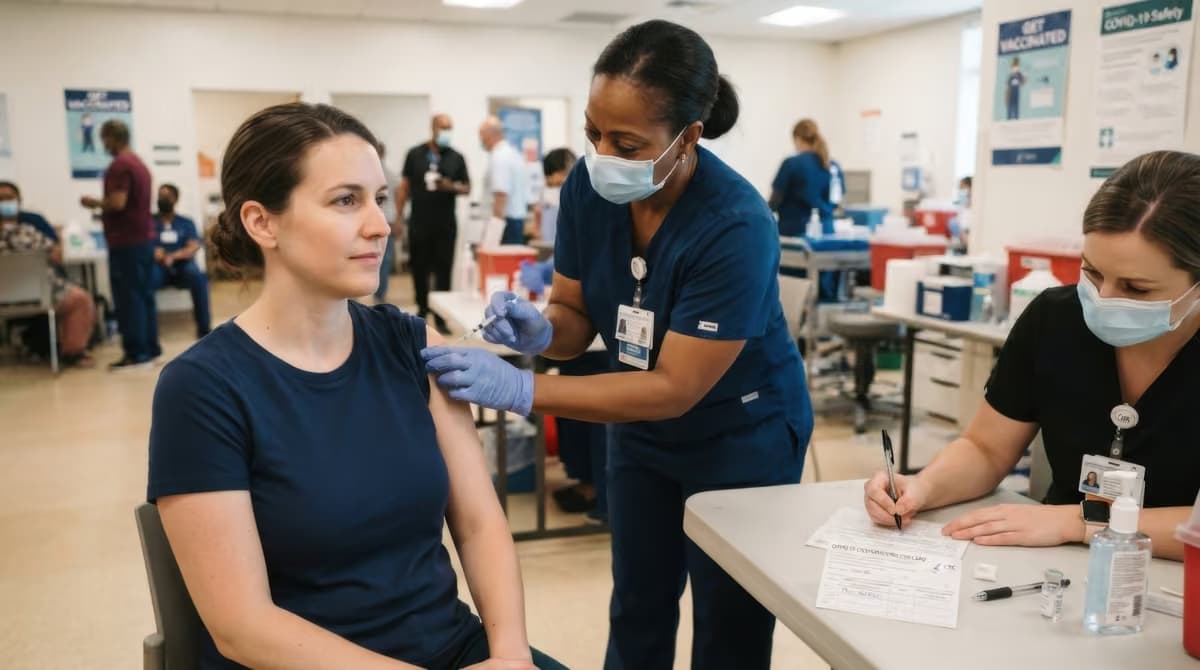
Pell Grants for Healthcare Certificates and Associate Degrees
You want to train as a medical assistant, pharmacy technician, dental assistant or medical biller, and you're hoping a Pell Grant will help pay for it. A Pell Grant can pay for a healthcare certificate or associate degree when the school takes part in federal student aid and your specific program is eligible: associate degrees generally are, while certificates depend on their length, and programs shorter than 15 weeks qualify only if they are approved for the new Workforce Pell.
Every rule below was checked on November 9, 2026, in the Department of Education's 2026–27 Federal Student Aid Handbook and on ed.gov. For the 2026–27 award year, the maximum Pell Grant is $7,395. How much Pell Grant money you can get explains how that amount is set.
Step 1: Check That the Program Is Title IV Eligible
Federal student aid, including Pell, comes from the Higher Education Act's Title IV programs. A school that participates in Title IV can still offer some programs that aren't eligible, so the question is always about the program, not just the school.
The Handbook's program eligibility chapter sets the main tests:
| Program type | Pell eligible? |
|---|---|
| Associate degree at an eligible school | Yes, if you meet the student rules |
| Certificate of at least one academic year at a public or nonprofit school, leading to a job | Yes |
| Certificate at a career school with at least 600 clock hours (or 16 semester / 24 quarter credits) over 15+ weeks | Yes |
| Short-term program of 300 to 599 clock hours over 10+ weeks | No: Direct Loans only |
| Program of 150 to 599 clock hours over 8 to 14 weeks, approved as an eligible workforce program | Yes, through Workforce Pell (Step 3) |
| Online or hybrid version of an eligible program | Yes, on the same basis as on-campus programs |
Healthcare programs have one more test. The Handbook says a school must determine that each eligible program is programmatically accredited when the state requires it, and that it meets the state's educational requirements for any license or certification exam you'd need to work in that occupation. That applies in each state where the school is located and where its distance education students live. If you'll study online from another state, ask whether the program meets your state's requirements.
Step 2: Know How Short Certificates Are Paid
Some medical assisting, dental assisting and pharmacy technician certificates are measured in clock hours rather than credits. The Handbook's enrollment intensity chapter treats students in clock-hour and non-term programs as full time for Pell. Instead of fall and spring semesters, the school pays Pell by payment period, usually a set number of hours and weeks.
Two things follow from that:
- A program shorter than a full academic year usually gets a share of the annual award, not the full $7,395, because Pell is paid for the payment periods you're enrolled in.
- A program longer than an academic year can run past your annual award. In one Handbook example, a student in a clock-hour program who has used a full Scheduled Award can get Pell for the remaining hours through Year-Round Pell, up to 150% of the Scheduled Award in an award year.
Ask the school how many payment periods your program has and what Pell would pay in each.
Step 3: See Whether Workforce Pell Applies
The One Big Beautiful Bill Act, signed in July 2025, created Pell eligibility for eligible workforce programs, and the Handbook's Pell eligibility chapter says it began July 1, 2026. Under the Handbook's program rules, an eligible workforce program must:
- Run 150 to 599 clock hours (or 4 to 15 semester credits, or 6 to 23 quarter credits) over 8 to 14 weeks of instruction.
- Be approved by the state's governor and by the Department of Education.
- Have been offered at the same length for at least a year before approval.
- Show completion and job placement rates of at least 70%, with tuition and fees no higher than a value-added earnings measure.
- Not use correspondence, remedial or English as a second language coursework, direct assessment or study abroad.
According to the Department's Workforce Pell FAQs (October 2026), the Department began accepting school applications on July 1, 2026, approved the first program on August 4, 2026, and is approving more on a rolling basis. Healthcare programs are among the first. On August 19, 2026, ed.gov announced approval of Ivy Tech Community College's 8-week Clinical Medical Assistant program in Indiana, and on October 22, 2026, a Phlebotomy Technician program at Pima Medical Institute in Arizona, the seventh state with an approval.
Three details matter for students:
- A bachelor's degree doesn't rule you out of Workforce Pell, but a graduate credential, or enrollment in a graduate program, does.
- You can't mark it on the FAFSA form. You file the FAFSA as usual, and the school's financial aid office flags that you're in an eligible workforce program.
- Online across state lines is limited. The FAQs say a school can offer an eligible workforce program online to students in another state only under a bilateral agreement between the two states' governors.
Because approvals are program by program, a short certificate is Pell-eligible only if that exact program has been approved. Ask the school directly.
Step 4: What CollegeHub's Directory Lists at Five Healthcare-Focused Schools
The CollegeHub directory includes five schools whose undergraduate offerings center on healthcare training: Ultimate Medical Academy, Carrington College, San Joaquin Valley College, UEI College and South University. Together they list 28 healthcare certificate and associate programs (15 certificates and 13 associate degrees), and all five report that financial aid is available.
| School | Program format (directory) | Healthcare certificates | Healthcare associate degrees | Tuition per year (directory) |
|---|---|---|---|---|
| Ultimate Medical Academy | Online | 2 | 6 | $14,000–$17,000 |
| Carrington College | On campus | 8 | 1 | $15,000–$20,000 |
| San Joaquin Valley College | Hybrid | 0 | 4 | $18,000–$22,000 |
| UEI College | On campus | 5 | 0 | $15,000–$18,000 |
| South University | Hybrid | 0 | 2 | Varies by program |
A few of the programs listed:
- Medical assisting: certificates at Carrington College and UEI College, and associate degrees at San Joaquin Valley College (Clinical Medical Assisting) and South University.
- Pharmacy: Pharmacy Technology certificates at Carrington College, a Pharmacy Technician certificate at UEI College, an online Pharmacy Technician Associate at Ultimate Medical Academy, and a Pharmacy Technology associate at San Joaquin Valley College.
- Billing, coding and office roles: online certificates and associate degrees at Ultimate Medical Academy, including Medical Billing and Coding and Health Information Management, plus Medical Billing and Coding at Carrington College and Medical Billing & Insurance Coding at UEI College.
- Clinical associate degrees: Dental Hygiene and Respiratory Therapy at San Joaquin Valley College, which list a hybrid format.
The directory files Carrington College's Veterinary Assistant certificate and Veterinary Technology associate degree, and its Massage Therapy certificate, under healthcare too; they're in the counts above. Ultimate Medical Academy is the only one of the five whose healthcare programs are listed as fully online.
The directory doesn't record program length in clock hours or whether a specific program is Pell-eligible, so treat this as a starting list, not an answer. Confirm aid eligibility for the specific program, at the campus or in the online format you'd attend, with the school's financial aid office. Other schools in the directory list healthcare and nursing associate degrees too.
Step 5: Ask the Financial Aid Office These Questions
Before you enroll, get answers to these in writing:
- Is this exact program eligible for Pell Grants? If it's shorter than 15 weeks, is it approved for Workforce Pell?
- Is it measured in clock hours or credits, and how many payment periods does it have?
- What is the program's cost of attendance, including tuition, fees, supplies, uniforms, exam fees and a living allowance?
- Does it meet the education requirements for the license or certification exam in the state where I'll work, and does it hold any programmatic accreditation the state requires?
- What happens to my Pell if I reduce my hours, take a break or need to repeat a course?
- Will I have a credit balance, and when would I receive it?
If you're comparing career paths before choosing a program, healthcare degrees by level, from certificate to doctorate lays out the options, and how to become a medical assistant covers training and certification for one of the most common routes. Then avoid the Pell Grant mistakes that cost students aid.
Looking for a healthcare certificate or associate degree? Compare accredited healthcare programs, formats and start dates in the CollegeHub directory.
Related Articles
Dental Assistant vs. Dental Hygienist: Training, License and Pay
Dental assistant vs dental hygienist: compare duties, training length, DANB and state rules, hygienist licensing exams, BLS pay and outlook, and bridge options.

Form 1098-T and Education Tax Credits, Explained
Form 1098-T and education tax credits: what boxes 1 and 5 mean, how the AOTC and Lifetime Learning Credit compare for 2026 and who in the family can claim them.

How Online Class Attendance Affects Your Financial Aid
Online class attendance and financial aid: what counts as attending, why logging in isn't enough, and how a missed week can cut your Pell Grant or loans.