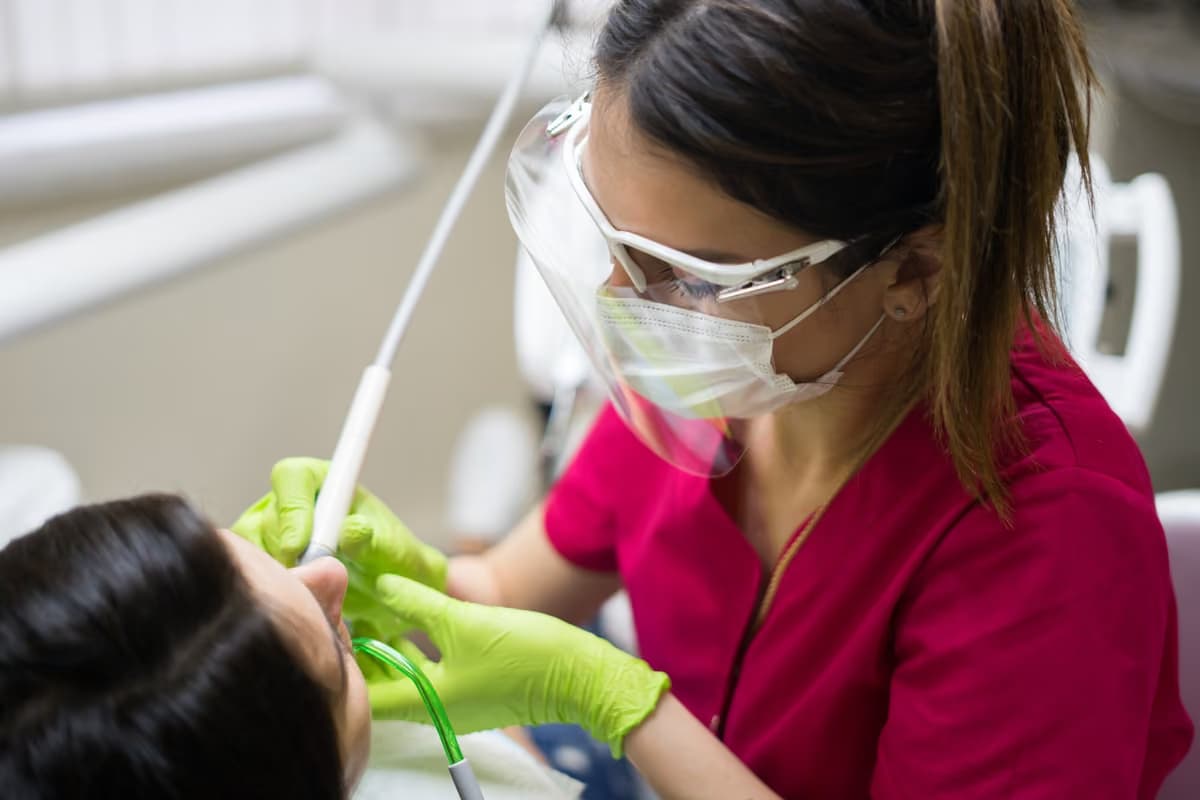
Dental Assistant vs. Dental Hygienist: Training, License and Pay
You want to work in a dental office, and you're deciding between a shorter program that gets you working soon and a longer one that leads to a license. A dental assistant usually trains for about a year (or on the job in some states) and supports the dentist chairside, while a dental hygienist needs an associate degree from an accredited dental hygiene program (programs typically take about 3 years) and a state license, and earns roughly twice the median pay.
Many people start as assistants and later move into hygiene. Facts below were checked on the official pages linked on November 10, 2026.
The Two Jobs Side by Side
All figures come from the Bureau of Labor Statistics (BLS) Occupational Outlook Handbook pages for dental assistants and dental hygienists.
| BLS measure | Dental assistant | Dental hygienist |
|---|---|---|
| Main duties | Prepare patients and rooms, sterilize and pass instruments, keep mouths dry, records and scheduling | Clean teeth, apply sealants and fluoride, take x-rays, assess oral health, teach care |
| Typical entry education | Postsecondary nondegree award; in some states, no formal education | Associate degree in dental hygiene |
| Program length | Most programs about 1 year (certificate or diploma) | Programs typically take 3 years |
| License | Usually not required at entry; some states require it for expanded duties or x-rays | Required in every state |
| Median pay (May 2025) | $48,070 a year ($23.11 an hour) | $98,100 a year ($47.16 an hour) |
| Projected growth, 2025–35 | 7% | 8% |
| Openings per year | About 53,000 | About 15,000 |
| Jobs in 2025 | About 388,600 | About 225,300 |
| Schedule | Most work full time | Many work part time, sometimes for more than one dentist |
Two things stand out. Assistants have more openings each year and a faster start. Hygienists earn more but invest more time up front, and the BLS notes that part-time schedules are common, so annual earnings depend on hours.
Decide What You Want the Job To Be
The duties are different in kind, not just in level. An assistant works alongside the dentist during procedures and often handles office tasks. A hygienist treats patients on their own schedule: cleanings, x-rays, assessments and patient teaching, then reports findings to the dentist.
| If this sounds like you | Consider |
|---|---|
| You want to start working within about a year | Dental assistant |
| You like variety, including front-desk and lab tasks | Dental assistant |
| You can commit to college-level science prerequisites | Dental hygienist |
| You want your own patient appointments and a state license | Dental hygienist |
| You want to test the field before a longer program | Assistant first, then hygiene |
How To Become a Dental Assistant
Check your state's rules
The BLS says each state regulates what dental assistants may do. Some states require graduation from an accredited program and an exam; others have no formal education requirement and assistants learn on the job. States that allow expanded duties, such as coronal polishing, require licensure, registration or certification, and some require a credential for x-rays or infection control.
The Dental Assisting National Board (DANB) keeps a state requirements page where you can look up job titles, exam and education pathways and allowed duties for your state. Your state board of dental examiners has the final word.
Choose a program
Most dental assisting programs take about a year and lead to a certificate or diploma, according to the BLS. The Commission on Dental Accreditation (CODA) accredits dental assisting programs as well as dental hygiene programs; use its program search and choose the allied category to check a specific school.
Consider DANB certification
DANB's Certified Dental Assistant (CDA) exam combines three exams: Radiation Health and Safety (RHS), Infection Control (ICE) and General Chairside Assisting (GC). It has 245 questions over 195 minutes. Eligibility pathways include:
- Pathway I: graduation from a CODA-accredited dental assisting or dental hygiene program, plus current hands-on CPR, BLS or ACLS.
- Pathway II: a high school diploma or equivalent, at least 3,500 hours of approved work experience, plus current hands-on CPR, BLS or ACLS.
Whether you need the CDA depends on your state; some states recognize individual DANB exams, such as RHS, for specific duties.
How To Become a Dental Hygienist
Complete prerequisites and an accredited program
The BLS says most dental hygiene programs require prerequisites, often including college-level courses, and the programs combine lab, clinical and classroom work in subjects such as anatomy, medical ethics and periodontics. Most states require a degree from an accredited program to get licensed. Check the program's CODA status in the same CODA search before you apply.
Pass the written and clinical exams
The BLS says most states require passing written and clinical exams. The two main pieces:
- National Board Dental Hygiene Examination (NBDHE). The Joint Commission on National Dental Examinations (JCNDE) says on its NBDHE page that the exam is accepted by all U.S. licensing jurisdictions and fulfills or partially fulfills the written exam requirement. It's a 9-hour test given at Pearson VUE centers. Students become eligible through their program director, and graduates submit proof of graduation from an accredited program.
- A clinical exam accepted by your state. The JCNDE launched the Dental Hygiene Licensure OSCE (DHLOSCE) in 2025; JCNDE lists Arizona, Kentucky and Oregon as accepting it so far. Other states use other clinical exams, so check your state board.
Apply for your state license
With your degree and exam results, apply to the state board of dental examiners, which may add its own requirements. The BLS adds that hygienists need continuing education to keep their license, and many jobs require CPR certification.
Can a Dental Assistant Become a Hygienist?
Yes, but not through a shortcut. Assisting experience doesn't replace the accredited hygiene degree or the licensing exams. What it can do:
- Help your application. Ask each hygiene program whether it considers dental assisting experience or a CDA in admissions.
- Let you earn while you prepare. You can work as an assistant while you finish the college-level prerequisites the BLS mentions, often science courses such as biology and chemistry.
- Show you whether you like the work before you commit to the longer program.
A typical path looks like this: complete an assisting certificate or train on the job, work while taking prerequisites at a community college, apply to a CODA-accredited hygiene program, then take the NBDHE and a clinical exam and apply for your license. Ask the hygiene program which of your earlier courses transfer; credits from a certificate program may not count toward an associate degree.
Dental Programs in the CollegeHub Directory
The CollegeHub directory currently lists three dental assisting and dental hygiene programs at three schools:
- Dental assisting certificate, campus: Dental Assisting at Carrington College.
- Dental assisting certificate, campus: Dental Assistant at UEI College.
- Dental hygiene associate degree, hybrid: Dental Hygiene at San Joaquin Valley College.
Hands-on training is central to both careers, so the hybrid hygiene program is likely to include substantial in-person lab and clinic work; ask how much and where. The directory records each school's institutional accreditation, not CODA accreditation, so look up each program in the CODA search and check that it meets your state's requirements. The directory also lists a pre-dental bachelor's degree, which prepares students for dental school rather than either of these jobs.
Paying for Your Program
Federal aid may apply to eligible certificate and associate programs. Our guide to Pell Grants for healthcare certificates and associate degrees explains how to check. If you're still weighing other short healthcare paths, compare how to become a pharmacy technician and how to become a medical assistant.
Comparing dental assisting and hygiene programs? Explore accredited dental and other healthcare programs at HealthDegrees.info.
Related Articles

How To Become a Pharmacy Technician: Training and Certification
How to become a pharmacy technician: training options, PTCB and NHA certification eligibility, state registration rules, pay and job outlook from the BLS.

Online RN-to-BSN Programs: How They Work and Who Qualifies
Online RN to BSN programs explained: who qualifies, how long they take, what the practice hours involve, and how to check accreditation and state rules first.

How To Become a Medical Assistant: Training and Certification
How to become a medical assistant: training options, CMA vs. RMA vs. CCMA certification, state rules, the in-person externship, and programs to compare.